The moment a child starts going to school alone, visiting friends independently, or spending time at after-school activities, the question of communication comes up. Most parents land in the same place: they want to be reachable, and they want their child to be able to reach them. The natural next step, in many families, feels like a smartphone.
It is worth asking whether that step is actually necessary, or whether it is just the most familiar solution to a problem that has simpler answers.

What Most Families Actually Need
When parents say they want their child to have a way to communicate, what they usually mean is specific and limited:
The child should be able to call a parent quickly. The parent should be able to call the child. There should be a way to send a short message. In an emergency, there should be a dedicated way to get help fast.
That is a short list. A smartphone delivers all of it, but it also delivers a great deal more — app stores, social media, browsers, games, and open internet access. For a child who is not yet ready to manage those responsibly, the bundle is the problem, not the solution.
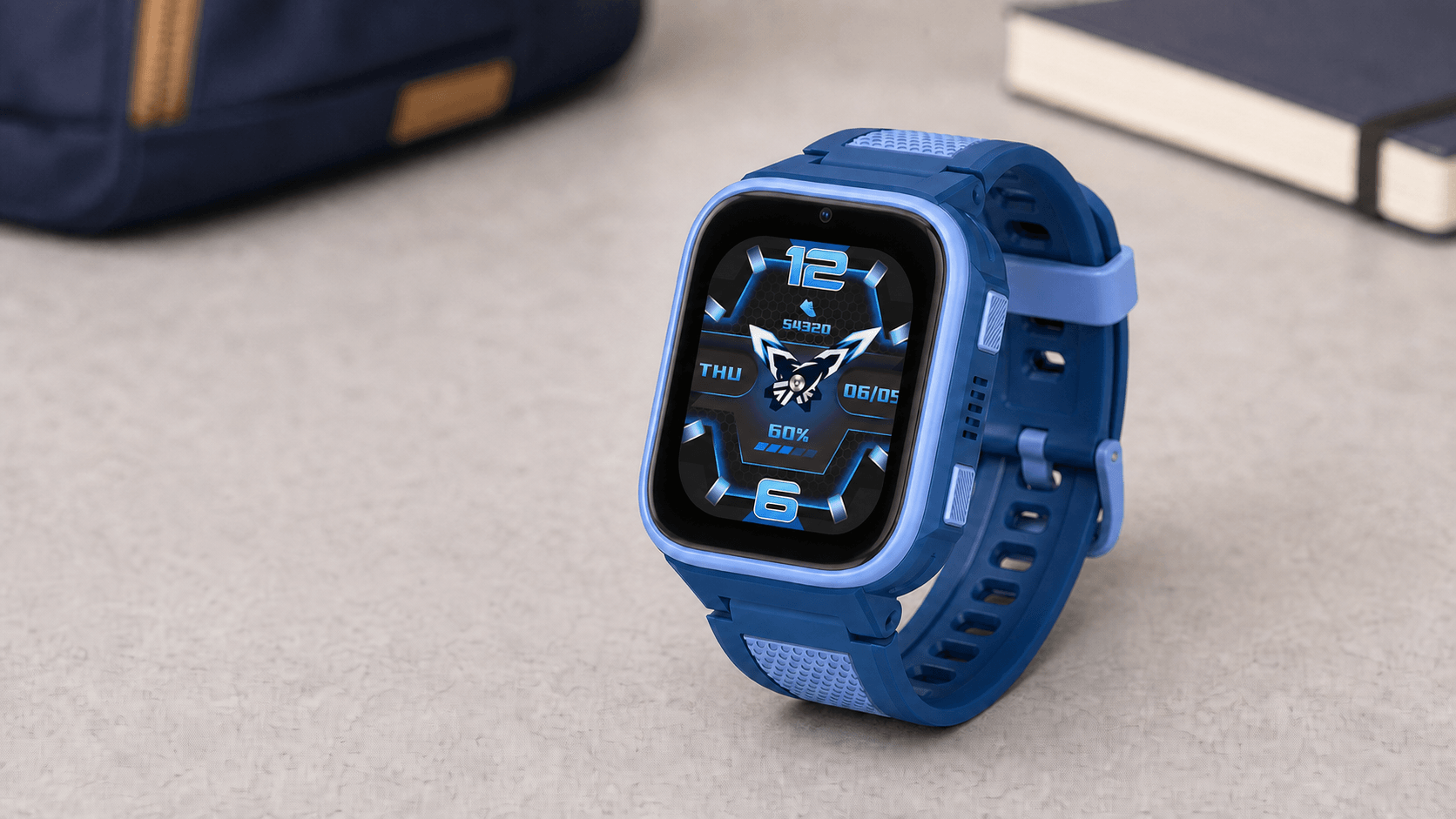
A kids smart watch separates the communication need from everything else. The LAGENIO K3 and K9 cover the list above directly, without the parts most parents are not ready to hand over.
How Family Chat Works
Family Chat on LAGENIO watches supports text messages, voice messages, and emojis. It works between the watch and the LAGENIO app on a parent's phone, and between the watch and any other LAGENIO watch in a group.
There is no open messaging. Children cannot contact anyone outside the approved contact list. There is no way to join groups with strangers, receive messages from unknown senders, or encounter content from outside the family network.
From the parent's side, the app handles messaging without requiring a separate messaging platform. A parent can send a quick text from the LAGENIO app and it appears on the child's watch. The child can reply by voice message from the watch.
This is a self-contained system. It does not depend on the child having a phone number associated with a messaging platform, an account with a third-party service, or any login credentials that could be shared or compromised.
The Difference Between WhatsApp and Family Chat
WhatsApp is a full messaging platform. It allows communication with any phone number in the world, group chats with unlimited participants, file sharing, location sharing, and calls to any contact. It is powerful, widely used, and completely unsuited to an eight-year-old without supervision.
The core issue is not WhatsApp specifically. It is that any open messaging platform gives a child access to communication that parents cannot meaningfully oversee. Group chats with classmates quickly involve children the parents have never met. Files and images from unknown sources can arrive without warning. The contact list grows beyond what any parent can track.
Family Chat is the opposite in every relevant respect. The contact list is fixed by the parent. The platform is closed. There are no unknown senders. There are no group chats with people outside the family network. The communication that happens on it is bounded by the decisions parents have already made about who should be able to reach their child.
This does not make Family Chat superior to WhatsApp for all purposes. It makes it appropriate for a specific age group and a specific set of needs, in a way that WhatsApp is not.
When a Smartphone Actually Makes Sense
A kids smart watch is not a permanent alternative to a smartphone. At some point, most children will need and be ready for the broader capabilities a phone provides.
That point is different for every child and every family. But the most common driver is not communication — it is independence combined with the social expectation among peers that everyone has a phone. Those pressures typically arrive in early secondary school.
Before that point, the communication need is almost always simpler. A child who needs to call a parent after football practice does not need WhatsApp. A child who needs to let their grandparent know they arrived safely does not need a smartphone. A child who wants to ask a question while doing homework does not need open internet access.
The LAGENIO K3 and the LAGENIO K9 cover these needs directly. The K9 adds Nio AI for question-and-answer interactions and a 5MP camera for clearer photos and video calls. Both include Family Chat, 4G voice and video calling, GPS tracking, school mode, and SOS.
Neither is a smartphone. That is the point.
Final Thoughts
The question of when to give a child a smartphone is genuinely complicated, and the right answer varies by family. The question of whether a child needs a smartphone in order to communicate with their parents is much simpler.
For most families with school-age children, the answer is no. The communication needs are specific and limited. A kids smart watch meets them directly, without handing over a device that comes with a much longer list of capabilities most parents are not yet ready to manage.
Family Chat is not trying to be WhatsApp. It is trying to be the right tool for a child who needs to stay in touch with their family, in a format that puts parents in control of who is in that conversation.
For many families, that turns out to be exactly what they needed — and nothing more.


Share:
How to Set Up Your LAGENIO Kids Smart Watch: Parent Setup Guide